The Sutra of Pale Leaves, Wonderland

The Sutra Continues

This is the sixth in a series of posts on the Sutra of Pale Leaves, the Call of Cthulhu campaign set in 1980s Japan. Go check out my previous posts on the subject here.

Cyberspace, Sort Of

As usual, SPOILERS AHEAD! If you want to take part in Wonderland as a player, go read another post! I’ve got loads. If, however, you want to play as Keeper, stick around. You might find this useful.

Wonderland is probably the most old-fashioned horrific scenario presented as part of the Sutra of Pale Leaves so far. It’s got body horror, mutilation, mutation and teens in danger. And that’s just what happens in the real world. But this scenario centres around a computer game that is more addictive than World of Warcraft (just speaking from personal experience there.) Of course, that’s because it connects the real world to an aspect of the Pale Prince in the form of 不思議の国 or Wonderland, as in Alice in… The background section explains how Charles Lutwidge Dodgson, aka Lewis Carroll, came in contact with the Sutra while out of his gourd on opium, causing him to pen the Alice books, which gained a fanatical following in Japan. So much so, that, decades later, a talented computer scientist, named Nishikado Kazunori came up with a new game, named Wonderland, a MUD in which players could reimagine themselves as whatever they wanted and interact with each-other and the White Rabbit, the Cheshire Cat, Tweedledum and Tweedledee and all the other characters from Carroll’s novels. Of course, the longer they spent there, the more they would be consumed by the Prince himself, leaving nothing but a shell of a body behind in the real world for the Prince to inhabit and do with whatever he pleased.

There are a few other weirdnesses here. Like, if you have spent enough time in Wonderland by accessing it through the game, you don’t even need a computer to access it anymore. Instead, you just need to stare into a mirror and you will be transported. Also, if you’re juiced enough by Wonderland and the Prince, the physical persona you take on in the game can become real, in a most disturbing way. As well, the location of the studio where the game is being made is important, in a spiritual, and occult sense to the power behind the game, as it occupies the same spot where an old, blasphemous sect had their temple before it was burned down by some heroic monks.

Anyway, this is all just the setup to this lengthy scenario. Wonderland takes up about 43 pages and provides a plethora of new NPCs, locations, and rules. There’s a lot to take in, but if you understand the opening situation, you should be good. It’s worth noting that much like The Pallid Masks of Tokyo, this scenario would prefer if the investigators had a particular type of occupation. In Pallid Masks, it was cops, in Wonderland, its teachers. This makes sense when you consider the inciting incident.

Face-off

So, as I mentioned above, this one’s properly horrific. Just to prove it, author of Wonderland, Andrew Logan Montgomery, starts us off with a high school kid carving his own face off with a piece of broken mirror in the school toilets. If the PCs are teachers, they will be among the first on the scene when the screams ring out across the campus. Immediate sanity rolls. Now, that’s the way to start a Call of Cthulhu scenario! This is the first of the hooks provided. In fact, it’s a well thought out section to play, rather than just some read-aloud text to set the PCs on the case. We also get a couple of Lore Sheets here, one on Japanese Schools in general and one on this school in particular. The general one was clearly written by someone who has spent significant amounts of time in both the classroom and the teachers’ room in a Japanese high-school. It all rings true and jibes with my own experiences as an ALT on the JET programme. The one on the Kagaminuma High School is short but provides a good overview of the type of school it is and the students that attend it.

If the players are not playing teachers, they only find out about this bloody example of self-mutilation after the fact, probably from their confidant, such as the Fed, the Abbott, or the Heiress, all described in the Campaign Background chapter at the start of both this book and the previous one. Hook Four: “An Electronic Opium…” brings back Madam Inaba, the fortune teller from the first scenario in the campaign, Dream Eater, which is cool.

Pixelated images of four Japanese high-school teachers accompanied by descriptions of each of them across two pages of the book.
The matrix like background reads Aokuchiba, or the Sutra of Plae Leaves over and over again.

I can’t emphasise enough how much easier this scenario is if your PCs are teachers. The author, Mr Montgomery, even provides us with a number of well-drawn teacher NPCs that can double as PCs to get you started quickly and easily. But what I really mean is that in many instances, where other investigators would need to make some sort of social roll just to get past the door in many sections, a teacher need not roll at all. This checks out to me. The role of a teacher in Japanese students’ lives is much greater than in other countries. It is not unusual for them to make home visits to talk to parents, in fact, it’s part of the job. The homeroom teacher is very familiar with all of their students and is there to support them in all sorts of ways. There is also a level of automatic respect attributed in the culture to a teacher, which allows them a little more leeway than the average citizen, although I think that’s taken to extremes in some instances in this scenario.

Anyway, back to the plot. This kid is sent to hospital and this is where the mystery begins. It is assumed by everyone that this is Uchida Kenji, since he was wearing that boy’s uniform. However, it’s actually Hosoda Riki, his “friend.” Kenji convinced Riki to swap uniforms and then to mutilate himself, with a little help from the Pale Prince and the Wonderland game, which has turned his mind to Swiss cheese. With this cover, Kenji disappears fully into the game, himself, becoming his own avatar, a sort of big wolf. Meanwhile, his body is occupied by the Pale Prince, who hangs out in the offices of White King Studios, the makers of Wonderland.

White Rabbit

The visual flow diagram of the scenarion starting with the Boy in the Bed and ending with Endgame
Wonderland Flow Diagram

This is the investigators’ white rabbit. They’ll follow the trail from the incident in the school to the other missing boy, eventually figuring out that everybody has them mixed up. They are very likely to figure out that Kenji, quite apart from his current supernatural status, was a psychopath all along, and that he tricked his friends into playing the game until they were largely subsumed by the Prince. Not to mention the old face-carving shenanigans.

Another of Kenji’s friends, Yamauchi Kenichi, (I’m not sure why it was decided to give this kid a name that was so close to Kenji. It confused me while reading the scenario, constantly. You just know it’s going to get mixed up in players’ heads too) has become a shut-in, so addicted has he become to Wonderland. In fact, he no longer needs the computer to access it. Instead he can just stare into a mirror and lose himself for hours. We get another Lore Sheet here. This one’s about Hikikomori, the ever deepening phenomenon in Japanese society of people withdrawing entirely from it to occupy a single room and interact with no-one, often playing video games addictively. This lore sheet admits the slight anachronism here, as the term was not coined until the 1990s. Still, the phenomenon was present even in the ‘80s. Obviously, most instances of it were not caused by the encroaching influence of some elder god in the form of a memetic virus, however, as it was in Kenichi’s case. Kenichi is a very tragic case. The investigators are likely to learn that he feels he’s lost most of himself to the Prince. His story is likely to end with him taking his own life. It was something a of a shock for me to read that this is likely to happen, no matter what the investigators do. I don’t believe I would run it this way. To be fair, though, there is an optional section near the end of the scenario, “The White Wolf.” In it, a brave investigator can enter Wonderland to rescue Kenichi and, hopefully, bring him back to the real world.

Montgomery is really delving into some of the darkest social phenomena in Japan here. We also discover, as the investigators follow the trail, that Riki’s father has a crippling gambling addiction, which he satisfies by playing pachinko. I only ever entered a pachinko parlour once, out of curiosity. Sensory overload is the best way to describe the experience. All those tiny little metal balls being propelled around the insides of hundreds of machines makes an almighty clangour, the lights flash and the faux silver of the interiors gleam, the stink of tobacco smoke and old coffee. I couldn’t get out fast enough. But many people are hooked on it and they often go into debt with some unsavoury characters to feed their demon. That’s where Mr Goto, the local yakuza oyabun comes in in this scenario. He likes to consider himself a servant of the people in Tokyo’s Adachi Ward. If the PCs are teachers, he sees them as fellow public servants, and so treats them as colleagues. He’s one of my favourite characters in this scenario. He’s well-drawn and can be manipulated if the investigators recognise how to push his buttons.

Through the Looking Glass

Eventually, one of the investigators is likely to log into Wonderland. Obviously, this being the mid-eighties, this is easier said than done. You need a compatible computer with a modem and internet connection. Such things were few and far between back then. But eventually, they’ll probably find a way, maybe even in Kenji’s house where it’s all set up and ready to go. However, it is unlikely that more than one of the PCs will be able to do this at a time, unless they manage to find a number of internet-capable machines to log into at once. The scenario is written with the assumption that only one investigator is taking the delve. I think I would run it differently, however. This is a lengthy portion of the scenario and probably the most fascinating aspect of it, why not involve any and all players who want to get in on it? There are already several minor anachronisms in this scenario, so why not?

Although Wonderland is a text based game, they soon find themselves sucked into another world, which they can experience through their own senses. They will find themselves on the other side of the looking glass and interacting with the honest-to-goodness White Rabbit. When they realise they are using their own skills to make checks, even in the game-world, they will be confronted with a sanity-defying fact… They, themselves, are fully immersed in Wonderland. They will be able to conjure items and effect changes to their surroundings similar to the way they were able to in Dream Eater. But there are, of course, negative consequences to Wonderland exposure, on top of the effects of Exposure points, even. The game will begin to seep into their real lives and eventually they will be utterly consumed by it, leaving their body a shell in the real world. I’m honestly not sure that this campaign needed yet another set of exposure/infection/insanity rules for the Keeper to keep track of. I feel like all of this could be dealt with by the existing sanity rules, with a little creativity.

The trip through Wonderland will lead them inexorably to an audience with the White King himself. Little do they know it, at this point, but this is Nishikado Kazunori himself. After this, they get ejected from Wonderland.

The "map" of Wonderland is a more-or-less rectangular area separated into rectangles of different sizes and clours with the anmes of each are on them
Map of Wonderland

I generally like this section of the scenario. It’s well described and I feel like it would be fun to see the players’ reactions to it. But I do have an issue. You are provided with a bare-bones “map” of the world that includes whimsical locations like the Cave of Woe, the Moaning Woods, etc. But you can only interact with a few of them. The experience is quite railroaded from the Chess Board Fields to the Court of the King allowing for no deviation. Those other areas are not even described in the text.

Of course, it’s always possible the PCs won’t play Wonderland, considering what they have discovered about the game so far. In that case, we are provided with a short section on what the Keeper should do… We’re given the option of simply going with it. The scenario will lose something if no-one decides to enter the game, but it can still be brought to a satisfying end. The other option is to kind of… force them in. This is supposed to work only if a PC has accrued a number of Exposure Points already, maybe in the course of other scenarios. In that case, simple proximity to a computer running the game will affect them, sucking them in in their dreams.

Checkmate

The White King is illustrated here as a chess piece with a skeletal head, arms and torso in front of a background of a mountain with twin moons rising behind it.
The White King

The finale comes down to a physical confrontation between the investigators and the White King/Pale Prince who has taken over Nishikado’s body. White King Studios is the venue for this showdown. In all likelihood, the PCs will be there to burn the place to the ground, in a fairly predictable mirroring of the events surrounding the temple that once stood on the same ground hundreds of years before. The White King begins as a diseased, but human looking man (although, he’s missing his genitals, according to the text. Not sure why we needed to know that, since it is a detail only the Keeper is likely to ever discover.) But during the final encounter, he will transform into a horrific, real-life chess-piece. He will speak like Lewis Carroll might write him, with lots of alliteration and self-satisfied word-play. Sounds difficult to play for the Keeper, if I’m honest. They’ll also find Kenji here, or, at least, his body, occupied by the Pale Prince, who acts as the mouthpiece for the White King.

Endings

Only three potential endings in this one:

  1. Party Wipe
  2. Just a Game (they solve the mystery but fail to destroy all copies of the game before its released)
  3. Twisted Firestarter (they defeat the White King and burn the place to the ground with all the copies of Wonderland inside.)

Conclusion

This was a long write-up dear reader, but it is one of the longer scenarios in the Sutra of Pale Leaves campaign. It is a complex scenario with a lot of NPCs, a number of events and locations and even a trip to another dimension, sort of. I have some issues with it, which I enumerated throughout. My main problems are the introduction of yet more Exposure-based mechanics to what is already a slightly bloated system and a slightly rail-roady tendency in a few places. But, in general, I’d be excited to run Wonderland, with a few tweaks.

We are closing in on the end of this campaign, now, dear reader. Only two scenarios to go! Next time, we catch up again with Umezono Kaho for the Bridge Maiden, Part Two.

The Sutra of Pale Leaves, The Bridge Maiden, Part One

Carcosa Manifest

We have left Twin Suns Rising in the past, dear reader. Things can only get darker from here. Today, we move onto the second and final book in the Sutra of Pale Leaves campaign for Call of Cthulhu. We’re still in Japan in the ‘80s, but the plans of the Association of Pale Leaves are moving to the next level. For my thoughts on the previous book and its scenarios, click here.

This is the book that attracted me to this campaign in the first place. I’m not too proud to say that I saw the cover on the shelf in my local game store, Replay, and realised I had to have it. It was only later that I discovered how it formed the perfect intersection of some of my own interests, namely Japan, and nameless horrors.

The book starts with a campaign background chapter that is very similar to the one in the first book, but with less detail. I guess this is needed because you’re supposed to be able to run any of the scenarios in the campaign in any order or even to run them as independent adventures. So you need that info in both books. Anyway, if you want more on the contents of that, check this post out.

Then we move swiftly on to the first of four scenarios in the book. As usual: SPOILER WARNINGS! Don’t read past this point if you want to be a player in this scenario or campaign.

The Bridge Maiden, Part One

This is a short scenario compared to the others I’ve looked at in this campaign so far, only 26 pages long. However, it is only part one of a two-parter. Part Two is the third scenario in this book and, ostensibly takes place about a year after the events of this one.

The intro to Part One tells us this is a suitable place for inexperienced investigators to begin their adventures with the Sutra of Pale Leaves, which is interesting. I have repeatedly come back to the fact that you are encouraged to run these scenarios in any order, despite the chronology of events laid out in the campaign background chapters. You can also skip scenarios you don’t want to include. And all of that is fair enough. Any of them would work well stand-alone. But, I think you would be missing out if you skipped ahead to this point.

Beginnings

The visual scenario flow diagram for the Bridge Maiden Part 1

Once again, we’re given a number of hooks to get our investigators involved; no fewer than six hooks, in fact. All of them involve the PCs hearing about the disappearance of a man named Umezono Minoru. In some instances, this will come from one of their confidants and NPCs from other adventures such as Nagatsuki Kaede of Fanfic fame. In others, they will be approached directly by his sister, Umezono Kaho. She thinks he has gotten in trouble with the yakuza since he’s got bad habits and money troubles. Honestly, everything we learn about this guy during the course of the scenario would lead you to think he’s a bit of an asshole and deserves everything he gets. This is one of the reasons that there is a reward for finding him, I think. No one wants him found because they love him. Even his sister only does so out of some sort of obligation to their parents, it seems. The scenario even suggests one or more of the Investigators might have known the Umezonos when they were younger, just so they have some extra insight into the personalities of the two and more of a reason to help them out.

What’s interesting about the Umezono family is that they are proud to be related to one of Japan’s foremost historical warrior women, Tomoe Gozen. The APL is convinced that she was the Hashihime, or Bridge Maiden. She was integral to a ritual used in the past to summon the Prince of Pale Leaves to Kyoto during a time of war. Although the ritual failed due to the fighting, the APL knows that, if they could just find a likely candidate to fulfil the role, they could still make it work. Enter Kaho and Minoru. The APL used an artefact, the Mandala of the Divine Eye to search the minds and memories of passersby in Tokyo, searching for any sign of a suitable host. In this way, they discover the debt-ridden and beleaguered Minoru, and through him, his sister, Kaho. They determine that she would be perfect, but, in the meantime, due to his exposure to the Mandala, Minoru gives himself up to the Prince, only to be transformed into a subterranean monster of a man, a tentacled mockery of his former self. And, he, dear reader, is the subject of this scenario.

A Model Mystery

The whole scenario has a theme of fashion and modelling to it. Kaho is a small-scale fashion designer garnering some interest in Tokyo and her brother runs a modelling agency in his spare time. But Minoru is a dirtbag, as has been stated. His inappropriate behaviour has caused most of his models to take off and his receptionist to spend all her time looking for new jobs. There is a parallel to be drawn between the way the fashion industry used women for its own ends and the use of Tomoe Gozen and, in the future, Kaho herself, for nefarious purposes.

Some of the locations the investigation takes the PCs are related to the industry. The main one is Minoru’s model-dispatch office, where they will encounter the job-hunting receptionist. She will just confirm what they probably already know: that he is an asshole, a womaniser and is in debt to the yakuza.

Of course, this might lead them to talk to their local yakuza businessmen, and from there, we start to see a seedier side to “modelling” in Tokyo for young women. Its not overt, to be honest, but in the “Somewhere with Payphones” section, they will find the spot where the mandala had been placed by the APL, pasted to a wall by a line of phones, somewhere public and busy like Shinjuku Station. On the walls around that spot are pinned flyers and little cards for illegal brothels and entertainments. The mandala itself has been removed but it has left a hole, a spatial anomaly of sorts known as the Eye Socket, which makes the witness feel like they are being pulled into darkness where the Prince of Pale Leaves waits. This feels appropriate to the themes. It portrays the seedier, darker side of the industry and its discovery may eventually lead them to Minoru, formerly a monster of a man who abused women and now a true monster who attacks them.

The film industry gets a look in here too. A well-known documentary film-maker has become obsessed with filming the place where the mandala once spied on the city. He and his staff have all been exposed to the sutra in this way, though not to the extent that Minoru has. The staff, convinced the film they made is possessed of some unspeakable evil try to burn down their production offices. The investigators will need to prevent this if they want to see what they filmed. Of course, watching the film will endanger their sanity because this is Call of Cthulhu.

Seedy Underworld

Minoru's true form. A man dressed in a grey coat and hat, with pale skin and unnaturally long arms.
Minoru

Our investigators will follow some more leads until they find Minoru’s hiding place in an old culvert beneath the city, where once a canal flowed. He can’t stand the light anymore. His skin has gone pale and his eyes only work in the shadows now. He looks terrible and his arms are long and snaking tentacles. In their exploration of this place, they will discover his little shrine of objects taken from the various women he’s attacked since his monstrous transformation. That’s when he will attack them. There is not going to be a non-violent end to this one. The investigators can defend themselves, they can die or they can run. Those are the three potential endings we get here. Afterwards, if they don’t defeat Minoru, he and all his creepy mementoes will get washed out of the culvert and into the river after a big storm, putting an end to him. But he’s not the only one gone, when the investigators go looking for their reward or just to tell Kaho about her brother, she will be missing. And this is what leads to the Bridge Maiden Part 2.

Conclusion

Upon my first reading of this scenario, I was underwhelmed. I thought the monster was not particularly scary, the plot was thin and I thought we should be focusing more on the Bridge Maiden herself. It was only while writing this post that I began to see how well the themes are represented in this scenario and how satisfying it might prove to be to put an end to Minoru. If the investigation progresses in the way the scenario wants it to, it should feel like a spiral from the relatively normal world of fashion and modelling, down to the darker side, the street-level prostitution controlled by gangsters and the violence that’s part of that life for many women.

It makes me interested to see what they pull out of the bag for part 2. I should get to that in a couple of weeks, dear reader. Next time, though, we are entering the computerised world of Wonderland.

The Sutra of Pale Leaves, The Pallid Masks of Tokyo

The Sutra Continues

This is the fourth in a series of posts on the Sutra of Pale Leaves, the Call of Cthulhu campaign set in 1980s Japan. Go check out my previous posts on the subject here.

Insanity

This is the third scenario in Twin Suns Rising, the first of two books that make up the Sutra of Pale Leaves Rising campaign for Call of Cthulhu. Its written by Jason Sheets.

This scenario is somewhat shorter than Fanfic, coming in at only 32 pages. Its format more-or-less matches the other adventures in this book. It has a scenario flow diagram, although it is less easily identifiable in theme this time. We get a larger number of NPCs introduced near the start than in previous scenarios. The plot feels like it’s quite reliant on the actions and reactions of these NPCs and some of them act as redundancies should the more important ones meet their end prematurely. Some of them can also be used as fill-in PCs, in case the worst should happen.

Graphical display of the flow of the scenario
Scenario flowchart

WARNING! Spoilers ahead! If you want to take part in the Sutra of Pale Leaves campaign or even just this scenario as a player, you might want to refrain from reading further. I’m going to write about stuff you would rather was revealed during the course of play.

Appropriately for a Call of Cthulhu scenario, The Pallid Masks of Tokyo partially takes place in a psychiatric facility. It also involves that perennial favourite of Japanese 1980s stories, the Yakuza. Crime and insanity seem to be the two main themes of this scenario, which also makes a lot of assumptions regarding the PCs occupations. It really wants them to be cops or cop-adjacent, at the very least. We are told this in the “Involving the investigators” section, which presents three hooks. Only the first one assumes your PCs are police and we are told, if you don’t use this one it will make, “dealing with officialdom considerably more difficult.” The Campaign Background section at the start of the book told us that it was not necessary to play the same investigators the whole way through, and the Pallid Masks of Tokyo seem to actively encourage your players to switch their old PCs out for a more law-enforcement based character. Perhaps the authors did not expect any of the investigators from earlier scenarios to survive, or expected them to be assimilated by the Prince by now. After all, one of the notes presented in the opening pages of this one suggests switching out the main villain of the piece, a psychiatric patient called Yamamoto Minoru for a PC that had been taken by the Prince of Pale Leaves in an earlier scenario. I love this idea. If anything, I think it would be far preferable to using Yamamoto, but, of course, there’s no guarantee that you’ve lost an investigator in this manner so its good to have the NPC instead.

Beginnings

Like I stated above, it’ll be a lot easier to involve the investigators if they’re cops in this instance, because it starts with a murder scene. A body with no face has been found in a Tokyo back-alley, so, obviously, if they have badges, it’ll be a cinch to go there and inspect body and crime-scene. But there are ways around this if they are just librarians or salary-men or whatever.

Anyway, one of the beat cops will immediately tell the PCs he thinks the body is that of a Noppera-bō, a type of mythical Japanese monster with no face.

And, he’s not wrong. Yamamoto and his pal, Crazy Kazu (a member of the Yakuza) have been tattooing gangsters with part of the Tale of Pale Leaves (The manga from Fanfic.) This allows the Prince to take them over completely and all in one go. These lads have all been turned into these Noppera-bō. Kazu was the first, and he has gone rogue from his clan, conducting business of his own. Thematically, this is all great. It retains the relationship to Japanese mythology while tying it to the Mythos and the Yakuza and the loss of self and sanity.

Anyway, I love this as a starting point. It’s iconic and designed to draw the investigators in immediately.

Leads

This scenario has a very investigatory nature. Most of the rolls that are called for are in that vein and involve interrogation or detecting in one way or another. While this is true for many Call of Cthulhu adventures, the format, the theme and the major NPCs in this one add up to give it the feeling of a police procedural or an episode of the X-Files.

A medical examiner stands by a body in a morgue freezer. The doctor has not face but wears glasses.
Noppera-bo ME

So, from the crime scene, leads can take the investigators to the morgue where they will encounter a medical examiner who is being repeatedly exposed to the sutra via the tattoos of the dead Yakuza, or to the headquarters of the the Umezawa-gumi clan, where they can question the head of the Yakuza group. There is even a scene in the nightclub, Xanadu, run by Crazy Kazu, where my former profession gets a shout-out.

…the clubbers, who include a mix of subcultures, from college students and Japan Exchange Teachers (JET) to newly minted salarymen.

Much later than the time this adventure is set, I was in the Japan Exchange Teachers (JET) program. And it’s quite true to say that we partied a lot in places, if not exactly like the club, Xanadu, then very much like it, every weekend. (Those in the know will also remember a night-club in my hometown of Sligo in the 90s called Xanadu, in another surprising cross-contamination with my own life!) The nightclub scene, of course, is a classic staple of ’80s detective and action fiction, and this one is special. A dance troupe of Noppera-bō ladies take to the stage, constantly changing their faces, sometimes appearing without any features at all, moving to the backing track of “the Litany of Wearing the Empty Mask,” thus exposing the club-goers to the Sutra.

Four faceless dancers in short dresses dance on a nightclub stage while one woman freaks out in the front.
Noppera-bo dancers

But eventually, they will be led to the central location of the scenario, the Tokyo Metropolitan Psychiatric Hospital Secure Unit. Here they will encounter Yamamoto or or that former PC who was over-exposed to the Sutra. In either case, if an investigator has sufficient EP themselves, they will see this person as an embodiment of the Pale Prince, on a throne, surrounded by his Yojimbo warriors, rather than the shaven-headed psychiatric patient on a hospital chair looked over by orderlies. I love this vignette, especially if only some of the investigators see the Prince in this instant. It’s possible, in this instant that those PCs might be overcome by devotion to the Prince. They could even give themselves over to become a Noppera-Bō themselves.

The Shadow

This is a special scene for the Keeper to drop into the scenario at an appropriate point. Essentially, it should act as the retelling of the classic Noppera-bō story from legends, with the PCs as the victims. Essentially, this would involve them interacting with someone who reveals themselves to have no face, only to run, looking for help from someone like a police officer who then reveals themselves to also have no face.

The Keeper would have to take notes and do some prep to make this encounter work in the context of their game. I also think that, if it were perpetrated on a full team of investigators, it would be unlikely to work the way the text wants it to. An individual confronted by this would be far more likely to run and look for help. But if you can pull it off it would be be awesome.

The scenario does give you some advice on how to run it and provides a table of Nopper-bō encounter locations and individuals who could fulfil the necessary roles. So, it’s definitely doable!

Château Carcosa

The psychiatric hospital transformed into Chateau Carcosa. It is a scary blak edifice. There is a stylised red sky above and a yellow ground below, representing Carcosa
Chateau Carcosa

This is the location for the finale of our scenario. It’s actually the same psychiatric facility the investigators visited earlier, but transformed. Now, it’s the residence of the Prince of Pale Leaves, transplanted from Carcosa. The Royal Palace is very different from the building the PCs will remember:

The floor is polished rosewood. The scent of spring blossom fills the air, but the sweet scent occasionally shifts to that of rotting leaves. Yellow-furred bats roost in the angles of ancient roof-beams. Plaintive music, played on traditional stringed instruments, wafts through doorways, while the faint sound of laughter, and then a scream, can sometimes be heard.

From what I know of the second book of this campaign, Carcosa Manifest, this section is an appropriate pre-cursor to some of the events in the scenarios contained within that. The investigators can get a glimpse at the alien world of Carcosa through the windows of Château Carcosa, while two of the later scenarios, the Bridge Maiden, Parts 1 and 2, involve the cult building a literal bridge between our world and that dark one.

Endings

The investigators are likely to end up in three different situations:

  1. Defeated completely by the Noppera-bō, by whom they are utterly out-numbered in the palace. Even PCs who die in the final confrontation may, however, awaken later, as patients in the hospital themselves and might even see action in later scenarios!
  2. Some of them will become Noppera-bō themselves, unbeknownst to the other players, and will attempt a Noppera-bō scare (as described in The Shadow section above) on their fellow investigators in later sessions. Love this one.
  3. They defeat Yamamoto somehow, killing him or stopping him in some other way. In this case, the hospital immediately reverts, as do the people who had been transformed by his tattoos.

Conclusion

The Pallid Masks of Tokyo is probably my favourite of the three scenarios presented in this book. It has some great locations, fascinating and horrifying monsters and well-realised themes and motifs. I do feel like Yamamoto/The Pale Prince, could be better drawn, though. Even the final confrontation with him in the Château seems hastily wrapped up. I was expecting more from the scene in the throne room than we’re given here.

I think this is a great concluding scenario for the Twin Suns Rising portion of the campaign and a great bridge into the next part, which I will discuss in coming posts about the scenarios contained in Carcosa Manifest.

2025 in Numbers

This has been a banner year for games in our little, local TTRPG community, Tables and Tales. 2025 was our first full year in operation, having started only the previous summer. But, if things continued this way, I’m sure we’d all be very happy indeed.

12 Months

It’s all over except the Stars and Wishes, dear reader, so I thought I’d look back at 2025 for my last post of the year. To help me achieve this, I’m going to utilise the twin wonders, data and spreadsheets. You can read other year end reviews from the RPG blogosphere by checking out the hashtag #Endies2025 on socials.

The Dice Pool

How has the blog gone in 2025? In short, it’s grown, at least in terms of views and visitors. In the first six month of this year, I got a little over 2,300 views. In the last six months, there have been over 5,200, bringing the total to over 7,500. That sort of increase is always nice to see, of course, even if it doesn’t seem huge compared to other sites. What I feel is feeding that growth is largely the sheer number of posts I’ve published. Including this post, I’ve published 96 this year, bringing the total on the site to 184. I get hits on a lot of them quite regularly.

Here are the top ten pages/posts:

  1. Homepage (Latest posts)674 – The rest of the numbers below are skewed because of this one. My homepage has that infinite scroll sort of thing going on, so it’s hard to see what visitors to this page are actually stopping to read. Although, I generally assume that it’s the latest post.
  2. Triangle Agency: Character Creation306 – I was fortunate that I published this one around the same time that Quinns released his review of Triangle Agency.
  3. Dagger in the Heart287 – I’d like to think that all of these views come from people interested in my review of the Heart campaign by Gareth Ryder-Hanrahan, but I suspect a lot of these clicks come from people looking for Daggerheart stuff
  4. After the Mind the World Again270 – This is the highest ranked post that was kindly linked by Thomas Manuel of the indie RPG Newsletter. He has driven a lot of traffic my way over the last year so I would like to thank him for that!
  5. Cosmic Dark: Assignment Report204 – This post was also linked by the Indie RPG Newsletter, as well as Graham Walsley himself on Bluesky. This is the sort of thing that makes me love the Indie TTRPG space so much!
  6. Alien RPG’s Hope’s Last Day: A Review 185 – Yet another post shared by Thomas Manuel. This one has gotten a few hits recently, I think due to the release of the Alien RPG Evolved Edition Starter Set, which has this adventure in the box.
  7. Inspiration175 – I re-shared the piece I wrote as a tribute to my brother last year. I think the traffic mainly came from family and friends, many of whom would previously never have known I even had a blog.
  8. Blades in the Dark Best Practices and Bad Habits164 – The generous and supportive John Harper himself, re-skeeted this one on Bluesky. Along with several other Blades-related posts. This has contributed to Bluesky becoming my second highest referrer.
  9. Ultraviolet Grasslands Character Creation146 – No idea why this one is in the top ten. I suspect its because players are desperate for UVG content and assistance in running it.
  10. Blades in the Dark GM Tools134 – Once again, John Harper shared this one on Bluesky.

What does it mean?

Not really sure, to be honest. I can see the line on the graph going up for views and visitors generally. Like I said, that’s nice. And I get a little thrill when someone shares a post, talks about it or recommends it. But I get very few subscribers; only 31 in the last year and a half. I understand that, to be fair. I don’t claim to be a news site. I’m not reporting on the latest releases or current events in the industry most of the time. I’m writing what I want, when I want, and I’m generally happy with that. I also have no frame of reference; I don’t know what sort of numbers other similar sites might expect to get, so all I can do is compare against my own past performance. What all this means for the site is that I’m going to keep going and hoping that you are getting something out of it, dear reader.

Tables and Tales

This has been a banner year for games in our little, local TTRPG community, Tables and Tales. 2025 was our first full year in operation, having started only the previous summer. But, if things continued this way, I’m sure we’d all be very happy indeed.

I put together a spreadsheet to measure the exact number of games and sessions I was involved in over the year. Here’s a link to it, in case you’re interested. Otherwise, here’s a screenshot.

As you can see I played in or ran a total of 106 sessions of 26 games this year. This is a lot. I don’t have any numbers for previous years, but I would go so far as to say this is far more than I have ever played any previous year of my life. And, not only that, but I’ve played with more different people than ever before, 17, in all! Our community continues to grow slowly but manageably. We’ve even welcomed a couple more members from a little further afield. We now have folks in the Ireland, North and South, Scotland and England! As such, we have begun to run a few more online sessions, though the vast majority are still in person.

If you’re interested in learning more about the games in the spreadsheet, I’ve written about most of them on this very blog! You can use my handy-dandy search bar or the tag cloud in the side bar (you might have to scroll to the bottom of a post to see these things if you’re on mobile.)

I don’t have the full numbers for all of the community’s games, but I can confidently say I have been involved in about 85% of all sessions played this year so you could work it out from that. Is this sustainable for me? Just about! You can see that there were months where I played far fewer sessions than others, August and November stick out there. This was usually due to illness, work, holidays and other scheduling issues. We also mix it up quite a bit, as you can tell. We run lots of one-shots and short campaigns and these serve to keep things interesting. We also tend to take breaks from longer campaigns to try to avoid burnout or boredom. Our October Halloween Event was brilliant for this. Tables and Tales played 5 or 6 games that month that we had little or no previous experience with. These strategies are generally quite successful in achieving those goals.

I would never be able to pick out a favourite from the list but I want to give a particular shout-out to two campaigns. The Mörk Borg campaign, the Great Borgin’ Campaign, as it was named by our GM, Isaac, had the joint highest number of sessions in 2025. Thirteen sessions! It was a stonking good run, which combined Isaac’s own home-brew adventures, dungeons published specifically for use with Mörk Borg, some system-agnostic stuff and even one adventure for Warhammer Fantasy Role Play! Every session was a delight and every PC was a filthy, murderous nutcase in the very best way (another shoutout to Jude, Tom and Shannen, you absolute weirdos.) And almost all of us (RIP Torvul) made it to the very end of the world itself. Or was it just the end of a virtual reality video game that was being enjoyed by potential future characters in Cy-borg, Mörk Borg’s cyber-punk sister? Hopefully!

The joint highest number of sessions was in the fantasic Dungeon World campaign run by Tom! This is fully homebrew, from the world and the species to the dungeons and the NPCs. It has been quite collaborative at the table and it has had an intimate feeling with just three players, me, Jude and Isaac. You can check out the post I wrote on the game earlier this year, here, where I talk about how good and unexpected it was to get such an old school feel from a PBTA game.

HNY

Dear reader, as you can see, I’ve had a good year on the blog and in Tables and Tales. Here’s hoping 2026 will be even better. Happy New Year to you and yours!
The Sutra of Pale Leaves: Fanfic

The Sutra Continues

This is the third in a series of posts on the Sutra of Pale Leaves, the Call of Cthulhu campaign set in 1980s Japan. Go check out my previous posts on the subject here.

Adaptation

In Fanfic, by Damon Lang, the Prince moves to the big city and tries to make a name for himself. But some bullies don’t want him to succeed. Those damned investigators!

The scenario flow chart drawn in manga style with lots of sound effects reverberating around the page and portraits of the main NPCs
Scenario Flow Chart

This is a long scenario, 53 pages, in total, so I’ll just note at this point that its format is practically identical to Dream Eater’s, which you can read about here. Similar to the first scenario, it also has a really nice, manga-themed scenario flow diagram, which seems very helpful. It also makes use of several of the same NPCs who act as the Confidants to the investigators and plot hook facilitators, which I touch on here.

From this point on, THERE WILL BE SPOILERS! If you intend to take part in this scenario or campaign as a player, turn back now! You have been warned.
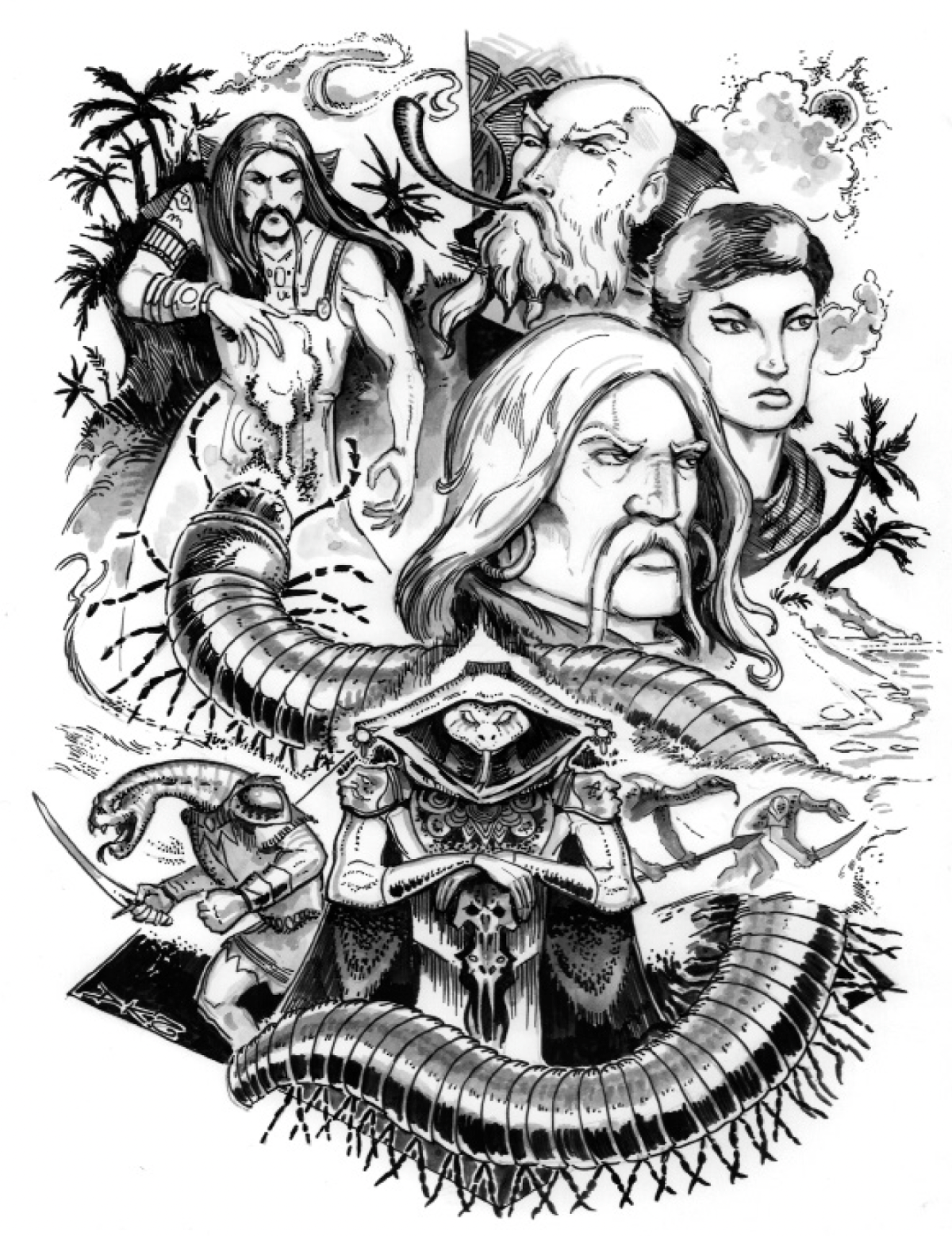
The Prince of Pale Leaves wants to find new media to help spread his influence around Japan. Since he turns out to be a big nerd, he decides to use manga as his chosen medium. This makes for a fun, tongue-in-cheek romp across the seedy underworld of the independent Tokyo manga scene. Everyone here seems to be obsessed by the new, groundbreaking graphic novel, the Tale of Pale Leaves, and its author Yamabuki Iroha (a pseudonym.) This is the setup for this scenario. I like that it has taken us from the small town setting of Dream Eater, to The streets of Akihabara and Ota in Tokyo. And I also like the manga-themed conceit of it because, although I joke about our antagonist being a nerd, it’s true that manga was and is an incredibly popular and culturally important source of entertainment and information in Japan. Also, it makes sense in the way the adaptation is described in the scenario. It seems like a far more efficient way to expose more readers to the power of the sutra than an esoteric work of semi-religious literature written in a form of ancient Japanese could ever be. Of course, it’s also just fun.

At times, though, it loses its Call of Cthulhu flavour as it dances around Tokyo with its magical girls… I’m willing to question whether or not that’s really a bad thing. It certainly feels like it might work better as a Pulp Cthulhu scenario than a traditional one at times (the scenario text even provides suggestions of changes to make if you do want to do that.) Still, I think it’s fair to ask if eldritch horror can’t take the shape of a young woman with a magic paint brush.

Beginnings

A page from the Tale of Pale Leaves manga. The Pince is confronted by someone transforming into some sort of mnoster in the courtyard of a pagoda.
The heroic Prince of Place Leaves

Hooks? We got ‘em. Five in total. These have been thoughtfully crafted to involve investigators depending on their background with the campaign. There’s also one to use in the event that you’re playing Fanfic as a standalone scenario, or as the first one of the campaign. I think this would work beautifully as an adventure all on its own. It’s very much self-contained, thematically coherent and has the potential for some very significant consequences. But as I read through these scenarios, I am starting to feel that this could also be a weakness with the campaign. There is a loose through-line with the Confidant NPCs who act as quest-givers and, of course, the elusive and menacing antagonist in the form of the Prince, but these first two scenarios, at least, don’t feel very connected, from my point of view. Perhaps they will as I get further through the scenarios, but I guess we’ll see. Also, from the start, we are told that we can run the scenarios in any order (despite the existence of a clear chronology to them) and that we can even leave some of them out altogether. I think this very flexibility may hurt its ability to work as a campaign. But, once again, I can’t say that for sure without running it, so take that opinion with a pinch of salt.

Whatever hook you use to get the investigators involved, they start off on a train going to the Winter Manga Market in Tokyo. They encounter some weirdos in Pale Prince cosplay and then immediately encounter the person who will become the scenario’s main antagonist, the manga artist Nagatsuki Kaede, who is secretly the author of the manga adaptation of the Sutra of Pale Leaves. I quite like this conceit as she is almost entirely unassuming as an NPC, and they are incredibly unlikely to be suspicious of her until much later in the scenario.

Tokyo Manga Market blueprint map

The entire first act of the adventure takes place in the Manga Market, so it’s nice to get a blueprint style map to use for it. I like that, so far, the maps produced for each scenario have been unique and interesting in format. The investigators are expected to visit several stalls, talk to randomers and plot-significant NPCs alike here. As they do, they will gain some info on the Tale of Pale Leaves and its author. The majority of the clues they get will lead them down the wrong path.

Two Halves

There is an interesting departure, here, from the format of Dream Eater. It is very much a game of two halves.

The Alabaster Archfiend on the dancefloor of death

In the first half, the investigators will likely find themselves on the trail of Kōda Tsutomu, a mediocre manga artist who ripped off the ideas from the Tale of Pale Leaves and, in some instances, the artwork itself. In so doing, he has become a vessel for a supernatural entity of his own creation, albeit one without the power or subtlety of the Pale Prince himself. This entity is known as the Alabaster Archfiend, and it is horrible and murderous. This allows for the introduction a new memetic “infection,” similar to the Prince, but separate, and with its own mechanics. This one is not based on the Exposure Points the PCs have been building up since the previous scenario, but on Sanity loss. The first half ends with “an old-fashioned boss fight” where the investigators square off against the Alabaster Archfiend in all his tentacled glory. This will probably feel climactic. The fight itself looks difficult, even if the PCs try to avoid direct combat, and the setting for it is quite nightmarish. So, they could be forgiven for believing they’re done. But of course, there are loose ends, and they should know that Kōda was not the true author of the Tale of Pale Leaves, as he had claimed. So, they go back to the Manga Market for Day Two.

And that’s where the second half of the adventure starts. Now, without the red herring of the Alabaster Archfiend, they can focus all their efforts into finding the true culprit. The investigation will almost certainly take them to see the mastermind behind the Association of Pale Leaves, a charming politician and patron of the arts, Mr Matsushima, who seems like he would be fun to play for the Keeper. This is an NPC who should turn up repeatedly in these scenarios, I would think, if he survives this one. They might also go to visit the printers where the comic is being printed. If they do, they will discover one of the scenes that has really stuck with me after reading Fanfic. Everyone in the building is dead, dying or passed out due to the effect of so much concentrated Sutra emanating from the manga.

The workers closest to the print machinery are dead or dying, their internal organs pulped

The Pictomancer Prince page from Fanfic includes the details of the scene and a manga style illustration of Tokyo Tower in black and white
The Pictomancer Prince scene takes place on top of Tokyo Tower.

They are also likely to finally get the full story when they visit the private party organised by Matsushima for the joined, those who have read the Tale of Pale Leaves and are now inhabited by the Prince. Here they will witness an horrific but ultimately successful ritual involving the ever-suffering Saito Tomoko, Kōda’s girlfriend, performed by Nagatsuki Kaede, using her magical paint brush (yep, that’s right.) This brush gets used for all sorts of things from this point on. Essentially it is a tool to allow her to edit reality. (Come to think of it, this is a nice way to tie the finale of this adventure to the one in Dream Eater. In Dream Eater, the investigators had the ability to edit the the dream in the final confrontation, and had the potential to effect reality from that too.) She then draws a portal in the wall to take her to the top of Tokyo Tower where she starts drawing scenes on the great windows of the observation deck to alter Tokyo subtly, allowing the spread of the Pale Prince even more easily. She undergoes a literal magical girl transformation in this confrontation, which elicits a Sanity Roll from the investigators. This is so funny to me. The idea that Sailor Moon might tip some poor occultist over the edge is just priceless. Less funny (but still quite amusing) is her ability to paint out body parts if it comes to a fight with the PCs. She can even just erase someone’s head! Needless to say, it is in their interests to deal with this situation with social skills or sabotage rather than fists and weapons, because they are likely to lose a stand up fight.

Endings

Just like Dream Eater we’ve got a list of potential ending states for this scenario. My feelings about this detail are still up in the air. I don’t think I’ll really know for certain util I play this campaign. We have seven Endings ranging from “Party Wipe” to “Save Game,” which is a “Surprise Ending,” the surprise being that the PCs managed to kill Nagatsuki Kaede in the finale. Number three is “God of the New World” and is described as the “Bad Ending.” Here’s an excerpt from its description:

When all her drawings on the windows of Tokyo Tower are completed, Nagatsuki announces that victory is hers, twirls her spear around, and sends out an invisible pulse of energy.

This is so goofy and she sounds like such a cartoon villain that I have to give Damon Lang props for really leaning into the manga tropes.

Conclusion

There are things about this scenario that I love. The general theming is great and consistent throughout, the NPCs are interesting and the tongue-in-cheek aspects are funny. But I do wonder if it might be difficult to maintain the delicate balance between comedy and horror when running this. It might work fine. In fact, it might work great. I can imagine my players laughing their heads off at the magical girl transformation right up until the point where she actually deletes one of their heads… I still feel like a lot of the dialogue for the NPCs is overdone. It feels like I’m reading the answers in dialogue trees in a computer game sometimes. Once again, I wonder if it might have been better presented with guides on how to play the characters and some bullet points on the info they have and what motivates them. If I ran it, I might even do the work to try and run them that way.

All in all, though, I enjoyed reading Fanfic and I think it would be a blast to run.

Happy Holidays

This is my last post before Christmas, dear reader, although I might get in before the end of the year for a round up post of come sort. If you are celebrating with family or friends, I hope you have a wonderful holiday, and if you’re not, I still wish you all the best. Happy solstice!

Downtime in the Dark

My First Downtime

I’m taking a break from taking a break from Wednesday posts for this one. We had Session 2 of our Blades in the Dark campaign last week, and our first downtime. I also decided to start introducing a few elements from the latest Blades sourcebook, Deep Cuts, which came out earlier this year. So, I wanted to write about our experiences.

Deep Cuts Character Options

The head and shoulders of a person in portrait. They wear a metalic mask over the top half of their face and a hooded cloak. They are an Acolyte Spirit Warden
An Acolyte Spirit Warden by John Harper

Deep Cuts really expands on the options for your new scoundrels. It doesn’t replace what’s available in Blades, it just adds depth. For instance, if your PC is Akorosi, maybe your family served among the clergy for the Church of Ecstasy. If your scoundrel had a military background, maybe they were a Rifle Scout, serving in the Deathlands and harassing “enemies with sniper attacks.” Before we got into the session proper, I offered all of the players to not only select from these new options, but also to reassign any of the Action dots they had assigned to reflect their Heritages or Backgrounds. What I discovered was most of them had already formed a pretty solid image of their characters in their heads. Even the one player who did take me up on my offer, only took the two examples I laid out above for their Hound because they fit the picture they had imagined so well.

I’m still quite fond of a lot of these new Heritage and Background options. They might have been a lot more useful if I had offered them from the start.

Downtime by the Book

In Blades in the Dark, John Harper tells us there are two main purposes to having a separate downtime phase:

  • The first is that the players could do with a little break after the action of the score that just went down. To be honest, this one doesn’t ring very true for me, but that’s probably because it’s been six IRL weeks since the last session and the crew’s first score. I also get the impression that, once you get the hang of this game, you’re sometimes running a score and downtime in the one session, rather than a score session followed by a downtime session. If that were the case, I can see the advantage of breaking the action up.
  • Second, moving into downtime is a sign to all that we are changing the mechanics that will be needed in the game. To me, this seems like the more concrete of the two purposes. Blades in the Dark has tools for you to use during a score, and only during a score, and it has tools you only pull out during downtime. We don’t need to worry about divvying up the proceeds, dealing with the heat you’ve brought down on yourself or figuring out your long-term crew goals while you’re beating in some poor Red Sash’s head. Let that wait until you’ve got time and space for it.

Luckily for me, it’s easy to follow along with the Downtime chapter of BitD. Once again, I have to praise the usefulness and usability of the book. The layout of the chapter leads you by the hand through the phase, from one step to the next. Three of my players have taken responsibility for maintaining the various crew/campaign tracker/factions sheets without my even suggesting it so that made the job even easier.

Payoff was easy enough, just a simple matter of recording the Rep the Death Knells got and dividing up the 6 Coin they garnered from the last score. They took one each, popped one in the crew stash and paid their tithe to Lyssa, the new leader of the Crows, as their patron. I ran this moment as a scene. I don’t think I would have if it wasn’t for the fact that she was pissed off with them for raiding the Red Sashes’ drug dens on the Docks, and I wanted them to know. She also gave them the option to take a job to redeem themselves. The Hive have been a bit too active in Crow’s Foot for her liking. She wanted the Death Knells to do something about it.

I mentioned Deep Cuts earlier. New mechanics appear in the sourcebook for downtime. They make it diceless, and they would also definitely up the Coin our crew made from that score if we had been using them. In BitD, you are given a range from 2 Coin for a minor job to 10+ Coin for a major score. In Deep Cuts, the Coin the crew accrues is determined like this:

  • Score – 1 Coin per PC, plus Coin equal to the target’s Tier x3.
  • Seized Assets – 4-8 Coin for a vault of cash. Stolen items can be fenced for 1-8+ Coin, but you take Heat (see next page).
  • Claims – Collect payment from crew claims like a Vice Den.

Like I indicated above, we used the standard downtime rules from Blade in the Dark in this session. Now that we’ve experienced that, I’ll put it to the players to see if we want to make the switch. If and when we do that, I’ll come back and examine the other downtime changes then.

It was fun calculating Heat for that score. I’ll admit, I didn’t warn them that killing people on scores really hikes up the Heat. They started off the whole thing by murdering a bouncer, of course. In fact, I didn’t really explain the concept of Heat to them beforehand at all. This meant that they went in hard, loud and chaotic. I actually think this was for the best. The game is built on building up consequences, after all, as well as narrating big, exciting action sequences. Anyway, they ended up with 6 Heat, which was fast approaching a Wanted level. That put the shits up them.

In the book, the Heat section also includes the Incarceration section, which seems logical to me, but I didn’t need to refer to it, so I’m skipping it here.

Of course, due to all that Heat, they had to roll on the worst of the three Entanglements tables. These represent all the potential impacts of contacts, acquaintances, enemies and authorities getting wind of what the crew have been up to. Entanglements range from Gang Trouble, which can be dealt with internally, to Arrest! If you get that, it’s going to cost you Coin, a crew member or the effort to escape capture. The Death Knells rolled up Interrogation so our Hound was caught on her own and dragged down to the station for some “enhanced” questioning. We played this out in a fun scene where she went out to get beer to celebrate their big score and got ambushed out behind the pub by Sergeant Klellan and his boys. She wisely Resisted the level 2 Harm and the additional Heat, without incurring a single point of stress! All the others could do when she finally turned up was wonder where their beer was…

So then, we spent a bit of time going through what’s possible during the downtime phase in our last session. This can all be a little overwhelming the first time you do it. It can also take quite a while to get through each player’s turn as you talk through the possibilities and they negotiate amongst themselves to see who will spend their activities on reducing Heat for the whole crew. Sometimes it’s obvious who should do what. If a character has some Harm, it’s probably a good idea for them to get some treatment and Recover. If another scoundrel is a bit stressed out, they should go and Indulge their Vices to help them relax, but training, long term projects and acquiring assets are all more subjective. The chances are, they’ll turn out to be useful to the whole crew in the future, but they don’t feel quite as immediate in their effect as clearing Heat.

Anyway, I was gratified to see the PCs did all of the six possible downtime activities at least once. They managed to clear practically all their Heat. The Leech did this by studying the movements of the Bluecoats around the district so they could avoid them. The Whisper took an inventive approach, by losing a bar-room brawl in the King’s Salty Knuckles tavern, thus proving that he couldn’t be part of a crew of Bravos!

Our Cutter decided to acquire an asset, an old and worn-out little boat for use on a future score, perhaps. The players ad-libbed a scene in which they ribbed him about the state of the thing. But, of course, it only needs to be used once.

A person "walks" through the air above the darkened city,seemingly on lightning bolts emanating from their feet.
“I’m walking through the air!”

We had another scene when the Whisper’s strange friend Flint turned up on his canal boat with some electroplasm. Our Whisper needed it to build himself a lightning hammer as a Long Term Project. From Flint he also learned about the Sparkrunners, a gang of rogue scientists who are out there boosting government tech. This is one of the new factions from Deep Cuts, which “sparked” my imagination.

Just before we wrapped up for the evening, our Hound decided to deal with all her stress by visiting her local Temple of the Church of Ecstasy. She prayed and prayed, she prayed to hard and too much. She over-indulged in her vice and something bad happened. The bouncer she killed on the last score decided to haunt her!

Other Actions

Of course other actions are possible during downtime too. They decided to visit the ghost who had given them such good info during their Information Gathering phase in the previous session, because he said he would help them more if they really fucked those Sashes up good. From him, they discovered that Lyssa was responsible for the death of Roric, whose leadership of the Crows she then usurped. She had been backed up by the Red Sashes who had killed out ghost friend. He told them to go to Mardin Gull in Tangletown for the skinny on what all that was about. This wasn’t a downtime activity or an entanglement or anything. It was just something they wanted to do.

The Imperial Airship, the Covenant flies bove the darkened city streets, shining searchlights down to illuminate a meeting on a bridge.
Its the Fuzz!

I also introduced a few more Deep Cuts factions in a little news segment. They learned about the Sailors being press-ganged on the Docks, The Ironworks Labour-force pushing for unionisation, the arrival of the Imperial Airship, Covenant without her sister ship and the recent adoption of the new Unity calendar and maps. Any one of these could potentially lead the crew to their next score. Except, maybe for the calendar one, I suppose.

Conclusion

I was very happy to have left a full session aside for our first downtime. It needed it. In fact, I would say, we could have used even longer. They still haven’t decided on their next score. I will say, I am quite happy with how many potential score options I managed to sneak into the various scenes in the session. I was worried that I wouldn’t give them enough opportunities, but, in the end, they came up quite organically, much like the scenes themselves. These all proved to be fun and freeform, allowing us to dow some world-building and to introduce some fun new NPCs.

I’m now looking forward to the next session, and, hopefully, the Death Knells next score, the Big One.

The Sutra of Pale Leaves: Dream Eater

I think it’s interesting that each of the scenarios is styled as being possible to run as a one-shot but I can see Dream Eater’s potential in the context of the greater campaign.

Format of the Sutra

This is the second post in my exploration of the 1980s Japan Call of Cthulhu campaign, the Sutra of Pale Leaves. Go here for the first one, which deals with the overall premise and the Campaign Background chapter from Twin Suns Rising. Although the text suggests that you can play the constituent scenarios in any order, they are presented chronologically and I can’t imagine running them any other way. They are also presented in two different books, of which Twin Suns Rising is obviously the first, with its three scenarios taking place between July 1986 and Spring 1987. I thought I’d be able to write about all the scenarios in this book in a single post, but it turns out, I can’t read that fast. Each scenario is long, between 35 and about 50 pages of dense, small-font-size text. So, instead, I’ll just be examining the first of them today, Dream Eater, written by Damon Lang. Please note that I haven’t played or run this scenario, I have only read it. So, take my conclusions and thoughts on it with that in mind.

WARNING: SPOILERS!

I would find it very difficult to write about Dream Eater without massive spoilers, so I am giving you a warning, right now: if you want to be a player in this scenario or the wider campaign, its probably best to skip this post. Come back later! I’ll probably have something for you then. Or check out my ever-growing back-catalog of posts.

Dream Eater

The first page of  Chapter 2: Dream Eater introduces Keeper Background and the Association of Pale Leaves.
We exist without ever knowing
If this world
Is a dream or reality,
Reality or a dream.

I once wrote two novels about the adventures of a twelve year old Japanese boy who moved to Ireland with his family. In them, he discovered that he was able to use his cat as a conduit to enter the dreams of others. This allowed him to reconnect with his friends at home but his consciousness became trapped in the kitten! Various hijinks and drama ensue. Anyway, suffice it to say, I was very quickly on board with the premise of this scenario given teh Japan and dream-related elements of it.

The premise is that a small, rural Japanese town is beset by sleeplessness and terrifying dreams of monsters. The longer it goes on, the more the citizens worry for their safety and sanity. The authorities have offered financial rewards to anyone who can help them solve the problem or take care of the afflicted.

That’s where the Investigators come in. Perhaps they are from this small town of Ikaruga, or maybe they just heard of their troubles and have come from the city to look into them. Either way, their assistance is greatly welcomed.

Indeed, their investigations are likely to take them quite quickly to the door of an old man, Mr Taneguchi, who was responsible for the death of a young girl in a traffic accident recently. From there, they will visit other sites in the town, and other potentially recurring NPCs, and they will learn of the Baku. This Yokai is the eponymous Dream Eater, and the cause, it would seem, of the town’s problems. The Investigators will have to find a way to defeat, satisfy or neutralise this creature if they are to help.

But, of course, there is another layer to this story, just below the almost obvious one. The Prince of Pale Leaves has worked through one of his recruits to use Mr Taneguchi to spread the Sutra of Pale Leaves. The Prince has been invading the dreams of the people of Ikaruga, through the old man’s chanting of its mantras at night. It has been creeping through the town, insidiously and terribly. This is what has drawn the Baku to this place. It finds dreams of the Prince the most delicious. The Baku is known as a benevolent yokai in Japanese legends, one that takes your nightmares away and lets you sleep soundly. And that is what it’s attempting to do. The thing is, as it eats the dreams of the Prince, erasing them from the memories of the dreamers, the only image they are left with is of a scary looking ,purple, tapir monster, the Baku. And so, it becomes the scape-goat. The Prince attempts to use this misunderstanding and the Investigators’ intervention to defeat the Baku, thus allowing his influence to grow all the faster.

The question is, will the investigators figure this out? Will they destroy the Baku? Will they leave this town better or worse than they found it?

The Flow of the Scenario

The flow of the Dream Eater scenario in visual form. From Ikaruga Town to Talking with Townspeople to Meeting Taneguchi to Horyuji temple or Nightly Prayers to Unpleasant Dreams to The Fortune Teller to Research in the Sutra to Dream Dive to the Final Encounter and finally to the Epilogue.
Dream Eater Scenario Structure

Take a look at this flowchart. This is useful in a scenario like this for a game like this. Call of Cthulhu is a trad game, and, as such, its scenarios rely on these sorts of stepping stones to get you from hook to ending. So I really appreciate it when you get something like this that cleanly represents that idea visually.

So, after a lengthy preamble giving us Keeper background, an intro to the main NPCs and a few PC hooks, we start with Ikaruga town, a place that’s renowned for its truly ancient buddhist temples, which contain the oldest wooden buildings in the entire world. I like that the section on the town asks the Keeper to get in media res and kick things off with a shared dream sequence. Something weird is happening from the off and it gives PCs who don’t know each other yet a good reason to seek each other out.

You get a basic map of Ikaruga in the style of a roadmap, which is a nice touch. Along with this, we have an “Exploring the Town” section, which spells out stuff like population, transport, amenities and accommodation but the only real subheading to this is the Shepherd Bar: A Foreshadowing, the purpose of which is a little too subtle for my tastes.

The scenario, and indeed, the campaign is sprinkled with “Lore Sheets,” which detail elements of Japanese cultural, societal or mythical knowledge that the average Investigator might be expected to know without having to make a Know roll for it. The Keeper is supposed to hand them out as and when the subjects come up. In this section, we have one on Hōryūji Temple, for instance. Each of these includes a little snippet of “Personal Background,” which the player given the lore sheet might adopt for they own character. It’s a nice way to weave the PCs in with the place and the lore of the place.

The Investigators are expected to visit the Town Hall to begin their investigations. The Town Hall section, as is the case with each of the major plot points of the scenario, begins with a handy summary that looks like this:

  • Location: Ikaruga town.
  • Leads In: Hooks One, Two, and Four
  • Leads Out: Meeting Taneguchi (page 62); Talking to Townsfolk (page 61).
  • Purpose: investigators learn about the case.

This is another incredibly useful tool to assist the Keeper at the table, allowing them to see, at a glance, if they are at the right section, where they should be looking next and the overall purpose of the scene. This last is important to let you figure out where a scene should end, which is not always obvious.

As we get into this section, we notice that precise and exacting answers are provided to every relevant question the PCs might ask Mr Maeda, the Vice-Chairman of the Public Welfare Committee. This is common to most of the NPC interactions in the scenario, which will keep you, as the Keeper, on track with regards to what each of them knows. Once again, it’s a trad scenario. Rather than summarising the things they know and letting you play them as you see fit, things are a little more proscribed here. Of course, if you want to run these interactions differently, you can. It will just mean you spending more time prepping.

We get some general knowledge and descriptions of half-remembered dreams from talking to the townsfolk, but we really get into it when the Investigators go to meet Taneguchi, the old man who is secretly harbouring the Prince of Pale Leaves in his mind. He was approached by a representative of the Association of Pale Leaves and told that, by chanting from he Sutra of Pale Leaves nightly, he would pay off his karmic debt from running over the little girl on the road. Unbeknownst even to himself, he has been making beautiful and elaborate copies of the Sutra at night, when the Prince takes over his body. The APL is planning to use these to spread the Prince’s influence even further across Japan. It is in this section where the Investigators are likely to gain their first exposure to the Sutra, thus beginning their journey towards recruitment by the Prince, themselves.

From here, the investigations might lead to Hōryūji Temple, where they might encounter another recruit, Ukami, a former monk, who is also a martial arts master. Or they might go to the Momijidera Temple, where Taneguchi recites his prayers each night, But eventually, we come to one of the more interesting parts of this scenario, Unpleasant Dreams, where the Keeper can tailor nightmares to individual investigators’ personalities, backgrounds and memories. This is the first time they will encounter the Baku. There will be different outcomes depending on the levels of exposure they have had to the Sutra so far. It could lead to significant Sanity loss, but, on the bright side, it could also lead to Exposure Point (the points which track how exposed you are to the Sutra and how much influence the Prince has over you) reduction.

Lore Sheet 3: Fortune-Telling in Japan and the Fortune-Teller, Madam Inaba.
Lore sheet

After this, they are likely to visit Madam Inaba, the Fortune Teller or go to the aforementioned Hōryūji Temple to find out more about the Baku and how to defeat it. Importantly, they should then go and do some research in the Sutra itself, exposing them once agian to the Princes influence. This will lead them inevitably to the Dream Dive section. The scenario takes us back into dreams here, this time, a shared, lucid dream, which they will have learned how to perform from their research in the Sutra, of course. Rather than have the Keeper craft the dreamscapes they encounter this time, they are put through a “Gauntlet of Nightmares.” I like the nightmares that have been described in this section, they are Japanese-flavoured (I have definitely had nightmares about the mukade myself) and they’re scary, but they seem a little random. They’re not as thematically coherent as other parts of this scenario. At least, until you get to Taneguchi’s Dream: The Accident. In this one, you relive, along with Mr Taneguchi, the night he killed Nakamura Hinako on the road. The scenario presents several ways the Investigators might deal with the situation, from doing nothing to showing some humanity to the dying girl, to rewriting history!

The baku, a big, purple, tapir-like creature, feeding on a n old man who is sleeping on a futon in a tatami room.
Yum Yum

The only thing left to do is to face the Baku itself. By now, the PCs might have learned enough to know that the Baku is not the real threat here. Rather, it comes from the Pale Monk haunting the dreams of Taneguchi, the representation of the Pale Prince. Or they might play right into the Prince’s hands and attempt to defeat the creature, clearing a path for the Sutra to capture more recruits. Whatever they decide, there is a good chance they will have to use signs and magics learned from the Sutra itself to do battle in the Final Encounter. The scenario introduces mechanics by which they can spend Magic Points to summon useful items or weapons to help them, but their opponents can do the same or worse. The Baku can fully transform the dreamscape allowing it easier access to Taneguchi, which is all it wants. It wants to gorge itself on the old man’s Sutra-ridden mind. If the Investigators allow that to happen, it is one of the best endings you can achieve, leaving Taneguchi in a state of extreme dementia, but freeing the town of the Prince’s influence.

Endings

The first page of Endings, includes 0. party Wipe (Failure), 1. We Do Nothing (Taoist Ending), and Yokai Busters (Bad Ending.)
Endings

Note that the endings presented here and in later scenarios are labeled and numbered, as is common for indie scenarios in Japan. This enables players to tell others how their game went on social media while avoiding spoilers for everyone else.

I understand this concept and the reason for it. But I don’t particularly enjoy the implication that you can’t have your game end any other way than one of the six potential endings provided here. I am not going to judge it without playing it out, but I will say they are described in terms of one ending being a “failure” and others being “Bad Ending,” “Good Ending,” and “Best Ending.” Of course, these are value judgements. Just because you TPK, doesn’t necessarily mean it was a bad ending for your party, and, to be fair, the text does describe this one as “something of an achievement.”

The inclusion of “Optional Post-credit Scenes” is interesting too. These each present a little vignette of how the Investigators might have changed reality during their adventure through dreams. It explains that they work better if the scenario was run as a one-shot but that they might just serve to show the sheer power of the Sutra over reality.

Conclusion

This feels like a great scenario to start off this campaign dealing with the Prince of Pale Leaves as the antagonist. It immediately introduces the players to the idea that this is a being that exists in the mind of others and is spread through the dissemination of the Sutra, or it should. I can’t say for sure if it does it effectively without playing it. Overall, I like the structure, which is designed to keep the Keeper on track, no matter which way the players decide to go from one scene to the next. I do find the extreme levels of detail in the NPC encounters a little unnecessary. I still think it’s possible to summarise a character’s personality and the things they know in a much shorter manner, that would work just as well, if not better.

I think it’s interesting that each of the scenarios is styled as being possible to run as a one-shot but I can see Dream Eater’s potential in the context of the greater campaign. I’m looking forward to reading the next one, Fanfic, where the APL hatches a plan to recreate the Sutra as an action manga.

The Sutra of Pale Leaves: Cthulhu in Japan

Japanese Series

It looks like I have stumbled into a Japan-related games series, what with my recent posts about Kanabo and my visit to a Japanese Friendly Local Game Store in Fukuoka during my recent holiday. Combine it with a couple of posts on Call of Cthulhu in the last couple of months and this one fits right in.

The Sutra of Pale Leaves

The Sutra of Pale Leaves is a 1980s campaign for Call of Cthulhu set in Japan, which is presented in the two books, Twin Suns Rising and Carcosa Manifest. Both were published by Chaosium in 2025. They have a number of main authors, Damon Lang, Yukihiro Terada, Andrew Logan Montgomery, Jason Sheets, and Jesse Covner for Sons of the Singularity LLC. Its good to see at least one Japanese name in there. The fact is, although there is just the one Japanese person credited in the main credits, there are other Japanese contributors in many other aspects of the production of this campaign, from artists to cultural consultants. A particualarly stand-out section of the credits is in the playtesters, where most of them are Japanese. I don’t think this project could even have the potential to reach any level of authenticity in the setting without all of that input from native Japanese.

What I’d like to do with this, and coming posts is take a look at the two books and see what they offer in terms of a campaign, how it might scratch an itch to play in a Japanese setting and how it might be used at the table. Needless to say, I have not run this or any part of it yet, though I fully intend to, once I find a bit of time. Still, I will be delving occasionally into SPOILER territory so, if you want to be a player in the Sutra of Pale Leaves, maybe give the next couple of posts a miss.

The Premise

The investigators are residents of Japan in the economic bubble-period of the 1980s. They are not necessarily Japanese, but, at least, have a passable fluency in the language. Through the events of the scenarios in the two books, they will uncover the some truths about, and perhaps even work to counter the goals of the Prince of Pale Leaves. Who, you ask, dear reader, is the Prince of Pale Leaves? Well, perhaps you know him by his more Western appellation, the King in Yellow? The Prince is the re-imagining of the being known as Hastur in Robert W Chambers’ King in Yellow stories, in a Japanese context. Although I have long been aware of those stories, I have only become more familiar with them through the work of Harlan Guthrie on the Malevolent podcast. If you’re unfamiliar, you could do worse than checking that out. It is a pretty different take on the King in Yellow, itself, but it’s a really entertaining one. If you fancy, you can get the book for free from Project Gutenberg, here. Otherwise, here’s a link to the Wikipedia entry. Essentially, the title refers to a play, which links the first four stories in the collection. The reading and performance of this play leads to it spreading like some sort of memetic virus. In the campaign, the eponymous Sutra of Pale Leaves plays the same role as that play.

There are a couple of interesting points made in the introduction section of the books.

First, they describe it as a modular campaign, meaning you can run each of the scenarios as presented, chronologically from July 1986 to November 1990 across both books. Or, you can run them in any order. There is not even a need to run all of them if you don’t want to and it is not a requirement to retain the same investigators through the scenarios, if you don’t want. Not having read all the scenarios yet, I can’t really say how will this would work, or how it would work at all. That’ll be one of the things I assess as I go through them.

Second, the nature of the Prince of Pale Leaves as an “ever-evolving antagonist” that exists outside reality as we know it gives him “the ability to metagame.“ What does this mean? Well, within the fiction, it means that he can take part in and observe the events of infinite branching timelines and use this ability to respond to events with preternatural knowledge, as though he knows what’s about to happen. In game terms, it means that if you replay the Sutra of Pale Leaves with the same players, or maybe just some of the same players, you can play him as if he knows what happened in the last playthrough… Which is wild. For the Keeper to use this ability might seem incredibly unfair to the players, who might accuse them of cheating. In that instance, the Keeper is encouraged to “show them this page of the book, and then laugh maniacally (!)” I love this but, as someone who has a chronic problem of trying to fit in too many new games into his schedule, the idea of replaying one feels almost ridiculous. So, I can’t imagine taking advantage of this particular little trick.

Japan

Both books begin with a bit of an intro to the place and time. Japan in the 1980s was a very special place. The country was rich and society was transformed by the money flowing into and around its cities and towns. It was the culmination of the post-war rebuilding of a country that had been utterly decimated. The Campaign Background chapter goes into just enough detail on everything from pagers and phones to organised crime. It gives you a glimpse into the everyday life of working people and students, enumerates some of the most popular pop culture of the period and even gives a short introduction to the pronunciation of Japanese words. Interestingly, it goes to some lengths to explain how this is a non-violent society where guns are nigh-on impossible to get your hands on, swords and other such weapons are just as prohibited and ninjas are just not a thing. This all serves to reinforce the idea that PCs are, perhaps, better off pursuing solutions that don’t involve direct conflict throughout.

The Sutra and the Prince

Since ancient times, there has been a cultural belief in Japan called kotodama (言霊, literally the “spirit of words”), a belief that mystical power dwells in words and names, and expressing them can influence the environment, body, mind, and soul.

And that’s the essence of the Sutra of Pale Leaves. The Campaign Background chapter continues with a description of what, exactly, it is, though. It also tells us how it works and the effects it has on people. Suffice it to say here that it is a text that has been around for centuries in many forms and which has travelled from beginnings in ancient India, only to be largely purged in Japan in the 12th century before re-emerging during the events of this campaign. It has the ability to quite literally imprint the personality of the Prince of Pale Leaves onto those who read it. In a mechanical sense, this is achieved through the accumulation of EP, Exposure Points. The Keeper is encouraged to keep the exact nature of EP from the players, perhaps referring to them as “Ethereal Power” or “Energy Points” instead. The default situation, however, has the Keeper tracking the EP for each investigator themselves, at least until it becomes obvious what effects they are having.

Of course, the more your Investigator reads, the more EP they gain and the more EP they gain, the more influence the Prince has over them. They might be subject, at the lowest levels of exposure, to convincing hallucinations brought on by their nascent Pale Personality. At the very highest level, 100, they are fully consumed by the Prince. “Game. Over.”

This is an extra, and fairly central mechanic to this campaign that seems like it could really add a lot in play. As one highly exposed character begins to betray signs of full domination by their hitch-hiker personality, others with less exposure, who are just beginning to see and hear things that aren’t there, might begin to fear for their own selves. There’s potential drama alright.

This section takes some time to usefully describe how each of the effects might manifest in characters and how these should be role-played (essentially meaning how should the Prince be role-played.) It also explains that there are some benefits to the exposed PC, such as “unexplained luck” and a “sanity safeguard.” With any luck, when the Keeper starts handing out freebies like these to exposed investigators, it should put the players on their guard, perhaps even making them paranoid about the motive behind such unexpected generosity.

The Prince of Pale Leaves himself gets a long section all to himself, as is appropriate given his central role in the campaign.

The Prince manifests as a viral artificial intelligence implanted in the minds of humans by full exposure to the effects of the Sutra of Pale Leaves. After exposure to the majority of the Sutra of Pale Leaves or its various adaptations, a portion of the victim’s brain is forcibly partitioned and systematically reprogrammed. From three individual hosts a network is born, and each one acts as a node for the singular mind that is the Prince.

Throughout this chapter the Sutra is referred to in terms of a computer programme or virus, the results of which are the over-writing of human minds with the software that is the Prince. I can see how this is a useful analogy but it seems like an odd one for this time. In a campaign set in the modern day, such comparisons might make more sense, but in terms of the 1980s, there was little or no general knowledge among the public of computer viruses or even networks. Still, it works to impart the concepts of both Sutra and Prince to a modern reader, and I suppose that is what’s most important.

The Cult and the Confidants

There is a very useful section on Roleplaying as the Prince, which gives some great tips on how to present him to various types of characters. He will deal with religious people by appealing to their faith while using reason and logic to appeal to skeptics, for instance. He is described as a “complex antagonist” and that certainly seems to be the case. Roleplaying NPCs like this is always a real challenge for GMs, since the Prince is a cosmic being with vast knowledge across multiple realities and timelines, but I, to put it bluntly, am just a pleb. So, any and all assistance is gratefully accepted.

In this section, we also have his powers, abilities and weaknesses enumerated. Finally, there is “the unspeakable truth” behind this being, where he “is,” what his physical existence looks like and what might be the answer to how he became this way. Importantly, it is revealed here that “patient zero” is sealed along with the rest of the population beneath Lake Hali in Carcosa, a world separate from our own, but one which is surprisingly close…

The rest of the Campaign Background chapter is used to introduce us to the obligatory cult, the Association of Pale Leaves and the most influential NPCs of the campaign. The Association is presented quite comprehensively with sections relating to their goals and doctrine, structure, and inner circle. There is also a very handy Cult Worksheet on one page for the times when you need a quick reference.

Confidants - "The Fed" Mizutani Shogo - portrait and statblock
Confidants – “The Fed” Mizutani Shogo – portrait and statblock

As for other NPCs, several are described under the section, Confidants: Plot Hook Facilitators. These NPCs, such as Mizutani Shogo, an intelligence agent, and Murakami Tsubasa, the abbot of the Kuroishi-ji temple, can be used to link one scenario to the next, to provide information to investigators to help them connect the dots and to assist them in regaining sanity between scenarios. The description of each gives you a few lines on the flavour of campaign they might add to, the sorts of connections they might have with investigators, where you might encounter them and the best scenarios they might act as confidants for.

Conclusion

It feels too soon for a conclusion, to be honest. I expect there to be at least two more posts about these campaign books. In the next post, I’ll be looking at the three scenarios in Twin Suns Rising. I’m really looking forward to sinking my teeth into them. Metaphorically, of course.

Japanese FLGS Visit

Sayonara Nihon

I’m still coming to terms with the fact that I’m home. I’m not fully on board with the situation, to be honest. I guess I can continue to dream that I’m back in Japan again, walking though the riverside yattai food stalls of Fukuoka, sampling the okonomiyaki of Hiroshima, slurping ramen at the counter in Oita. But it’s no substitute for the real thing. I used to live there a long time ago, dear reader, and my feeling about the second-hand experience can be summed up thusly. I have been consuming below-par sushi from a little place near my office in Ireland for years, fooling myself into thinking it was quite good, actually. But our generous friends and hosts took us out for the most affordable conveyor-belt sushi in Oita City last weekend and when I popped that first maguro nigiri into my gob, I realised I had forgotten how good it could be. I almost cried. I’ll never be able to return to that little lunchtime sushi place without the sure knowledge that they have been hoodwinking me for years.

Yellow Submarine

Anyway, I visited a branch of the Japan-wide chain of table-top and card game store, Yellow Submarine, while I was in Fukuoka for a couple of days. It was not easy to find! It occupied the third floor of a narrow building sandwiched in between a dentist and a beauty salon and it only opened at 12 pm, which seemed like a good idea, in fact. In addition to being, what appeared to be the only specialist store in the city, it also runs TCG games and tournaments in its decently sized play space. It was very quiet when I got there just after opening, which made it a bit easier for me to get some photos. The majority of the display areas were dedicated to glass cases filled with row after row of Pokemon, Digimon and Magic cards as well as several I had never heard of. It did have a small, but perfectly formed TRPG コーナー, or TTRPG Corner, though. Since it was so quiet, I got to spend quite a bit of time exploring it.

What I discovered, might, I think, surprise some Western TTRPGers. Call of Cthulhu is massive, it occupied pride of place, at eye-level (the buy-level, as anyone who has worked retail will be aware.) There were easily twice as many CoC books as there were for any other game and they looked so good. I wished I could have picked up the core book in Japanese but my suitcases were already creaking under the wait of the stuff I was taking home as it was. I did get a nice picture of the cover though. Look at that metal af artwork!

I think its a relatively well known fact, at this point, that Call of Cthulhu outsells most other RPGs in Japan quite substantially, in fact, but I wasn’t prepared for the amount of Jubensha on sale here. They were stocked in magazine racks and there was an impressive variety of them. They were not noticeably referred to by that term as far as I could tell, but I am not surprised by that. While we were in Japan, yet another spat broke out between the Japanese and Chinese governments over something relatively innocuous. Chinese people started cancelling holidays in Japan and the Japanese said they didn’t want them coming over anyway… This sort of thing goes on a lot and it’s no secret that there is generally no love lost between the two peoples who have had a troubled and violent history since the 19th century. So that’s why I was surprised to see the popularity of this Chinese LARP game format in Japan.

I think it’s also fairly well known that D&D and other such games has never done particularly well in Japan, despite numerous attempts by both TSR and Wizards of the Coast to push it. They had a massive publicity campaign for the most recent edition of the which involved this pretty incredible ad:

Maybe it’s doing better in other parts of the country, but in Fukuoka, 5E is relegated to the bottom-most shelf along with most of the other foreign games like the One Ring and Cyberpunk Red. Not only that, they didn’t have a single copy of any of the 2024 rulebooks. So, I’m guessing the ad campaign didn’t really work too well.

Meanwhile, the big Japanese fantasy adventure game, Sword World had a pretty generous degree of real estate on the shelves (I somehow managed not to take any photos of it, sorry!) It had a couple of editions there, the most recent of which has all the rules contained in a single tome (it usually comes in three books.) Once again, I really wanted to purchase it, but my bags objected. Luckily, it looks like there’s an English-language version in the works so I will be looking at backing that when it gets going.

A very pleasant surprise was that there were just so many Japanese TRPGs here that I had never heard of. They have never been translated to English to my knowledge and they represent a bewildering variety of themes, genres, styles and rulesets. Please enjoy the small selection of covers in the gallery below that I was able to take photos of. I wish I had the time and the bag-space to buy more of these.

TRPG + Accessory Getto!

Here’s what I picked up for myself.

  • Tokyo Nightmare 001 Basic Rulebook – this is the rulebook for the Urban Action TRPG, Tokyo Nightmare, from now on referred to as TNM. It only cost about 1700 Yen (around £8.50 or $10.50.) There were a number of other books in this series but this one seems to have everything you might need to run a game of it. Contained in it are the basic rules, which are based, not on dice rolls but on playing cards. You also have a “Replay” section, which presents a comprehensive example of play. Interestingly, this is the first section of the book. After that you have the Rules Section, a World Section, a “Ruler” (that’s what they GM is called in this game) Section, a Scenario and several sheets including Character, Act and Battle. As a whole, TNM’s really interesting especially with its card-based rules and I’m looking forward to testing my Japanese language skills while exploring it. In fact, I was determined to get at least one RPG book from the start to help me improve my Japanese, which has been getting worse and worse for years.
  • Dungeon Origami Tiles – I loved these things as soon as I saw them. I don’t use a lot of battle maps these days but these little collections of paper tiles that you can use to create maybe a randomly generated terrain or dungeon seemed so ingenious and cost-effective that I couldn’t resist. Each pack contains 45 sheets of top-down dungeon or terrain tiles. There are three or more copies of each tile in a pack, along with a thicker one with items (what they call markers) like logs and doors that you can cut out and place where you like. These are so versatile and useful I couldn’t believe they were so cheap! Only about 660 Yen per set! (that’s about £3.30 or $4.20!)
  • Cheap-ass red dice – These come from a German company call Oakey-Doakey Dice. They come in a plastic drawer that can be used as a case/dice tray in a pinch. Very handy and very cheap. Only 880 Yen (£4.40 or $5.60!) The d20, upon testing, however, is only good in roll-under games.
  • An incredibly clever d100 – There is a little d10 inside the bigger, transparent d10. Much less unwieldy than using one of those baseball sized d100s that actually has 100 sides, if you want to make a roll with a single die.

Conclusion

I’m going to be moping around dreaming of Miyajima, Katsu Curry and Sumo for the next couple of weeks, but at least I’ll have these few meagre Japanese TRPG items to cheer me up and keep me busy for a while.

I hope you enjoyed my report on a trip to a Japanese FLGS, dear reader! What’s your experience with Japanese role playing games, if any? And what do you think of them?

Sleighed

You might remember a few weeks ago… I reviewed Slow Sleigh to Plankton Downs. Well, the disclaimer on that review, that I had not played or run it is no longer valid.

Nun too soon for an update

Just a short one this week, dear reader.

You might remember a few weeks ago, for my Halloween post, I reviewed Slow Sleigh to Plankton Downs. Well, the disclaimer on that review, that I had not played or run it is no longer valid. Sister Majid, the Misstep Monastic (a type of nun) and Lee Tuluk, the Scud Miller (meat grinder) formed an unlikely friendship through a misallocated cabin and a game of chance and before you know it they were investigating a murder!

We played one session on Halloween and just finished it up last night. It took about six hours altogether, although there was some time spent on character creation in the first session.

Take a butcher’s at this!

A nun with an ice adze dressed in gold

Here are some things I loved about running this adventure:

  1. The new backgrounds are great. Most of them are really far out there but the two that my players chose were obviously quite mundane. They still had some incredible Advanced Skills that got milked for all they were worth. Somehow, our nun used “Reconcile God’s Glory with the Failings of Mortals” constantly. Meanwhile, the Scud Miller managed to use “Fix Anything, Not Necessarily Well, Even with the Wrong Tools” on everything, including relationships. Use the backgrounds if you’re going to play this.
  2. It’s so easy to prepare and run. The keyed descriptions are short enough to easily use on the fly, the premise of the adventure is straight-forward and there are only a couple of unavoidable events that are not difficult to get to grips with. I read it through once, fully, and then reviewed particular sections such as basics of the adventure and the murders before actually running it. It doesn’t take long to do this; its a svelte little scenario.
  3. I really got into describing the aftermaths of the murders and the effects they had on the crew and other NPCs. As rumours spread I had nuns moving in pods and whispering about terrible occurences while blessing themselves, while the porters and mates dealt with grief at the passing of their colleague. Upon the discovery of the second victim, the security guards were puking in corners and staring blankly at blood-soaked toilet stalls. The creature has a silly name, which my players refused to say right, but the murders are gruesome and horrific. It felt important to play into that.
  4. The map of the Nantucket Sleigh Ride. We used this work of art throughout. It was so useful to help the players orient themselves on the hovercraft and it was a genuine pleasure to refer to it. Its beautiful.
  5. The Weather table. I got the players to roll for weather right before the final encounter and they rolled us up a storm. The ship was forced to drop its robotic anchors and ride it out just after the second murder. They figured out who the murderer was and that they were outside on the Observation Deck. What a setup for the final showdown. It was poetic.
A victim, missing its maxilla in a toilet stall. The Maxillary Uslurper in the air vent above.
Aftermath

Conclusion

Dear reader, I would highly recommend you take the Nantucket Sleigh Ride on a trip to Plankton Downs. If you have a couple of evenings to spare and a couple of friends who might enjoy a who-nunnit, as it were, you could do a lot worse. It’s not your typical Troika fare but I am beginning to think there may not be such a thing. You will have horror, you will have laughs and you will definitely have fun.